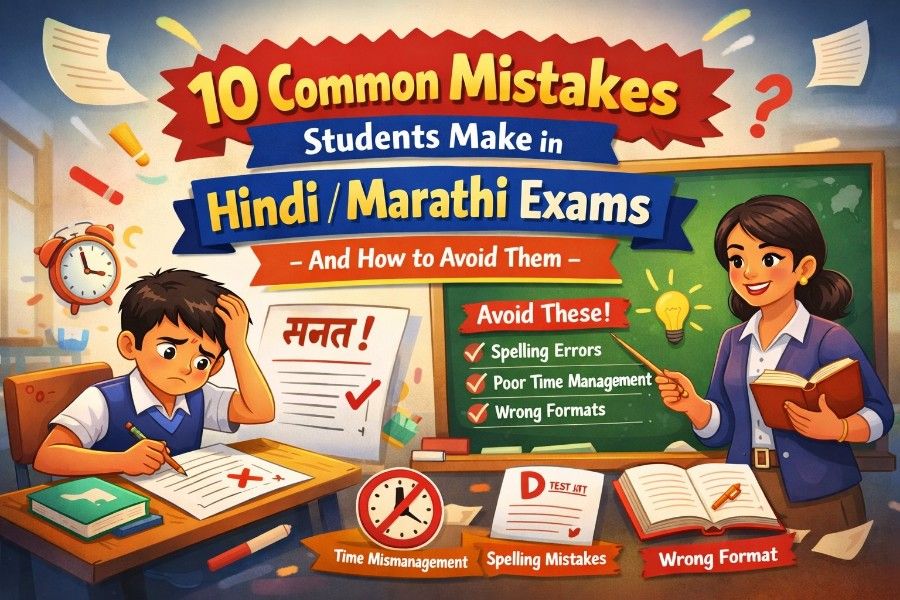
Language subjects like Hindi and Marathi are often misunderstood by students. Many students feel that since these are familiar languages, they do not require much preparation. However, in board-oriented exams such as ICSE and other school examinations, even small mistakes can lead to unnecessary loss of marks.
In my experience of teaching language subjects for many years, I have seen that most students lose marks not because they do not know the answers, but because of a few common and avoidable mistakes. The good news is that once students become aware of these mistakes, they can easily improve their performance.
Let us look at some of the most common mistakes students make in Hindi and Marathi exams—and how they can avoid them.
1. Not Reading the Question Carefully
One of the most common mistakes students make is not reading the question properly. In a hurry, they start writing without fully understanding what is being asked.
Sometimes the question may ask for a specific explanation, summary, or meaning, but the student writes something different.
How to avoid it:
- Read the question twice before answering.
- Underline or mentally note important keywords in the question.
- Take a few seconds to think before starting to write.
A careful reading of the question can prevent many mistakes.
2. Ignoring Proper Answer Structure
In language exams, the presentation of answers matters a lot. Some students write everything in one long paragraph without organising their ideas.
This makes the answer difficult to read and understand.
How to avoid it:
- Use short paragraphs for longer answers.
- Start with a clear introduction.
- Present ideas in a logical sequence.
- End with a simple conclusion if required.
A well-structured answer always leaves a better impression on the examiner.
3. Making Spelling and Matra Mistakes
In Hindi and Marathi, correct spelling and matras (vowel signs) are extremely important. Even students who know the answer sometimes lose marks because of spelling errors.
These mistakes usually happen because students write too quickly or do not revise their answers.
How to avoid it:
- Write slowly and clearly.
- Pay attention to matras and spellings.
- Always recheck your answer before moving to the next question.
With a little care, many of these mistakes can be avoided.
4. Writing Very Long Answers
Many students believe that long answers automatically bring more marks. This is not true. Examiners look for clarity and relevance, not unnecessary length.
Sometimes students repeat the same idea in different ways just to make the answer longer.
How to avoid it:
- Focus on quality rather than quantity.
- Write clear and relevant points.
- Avoid repeating the same information.
A well-written, precise answer often scores better than a long but unclear one.
5. Poor Handwriting
In exams, handwriting plays an important role. If the handwriting is difficult to read, the examiner may struggle to understand the answer.
Even a good answer can lose impact if it is not written clearly.
How to avoid it:
- Write neatly and at a comfortable pace.
- Leave proper spacing between words and lines.
- Avoid overwriting as much as possible.
Clear handwriting makes the answer pleasant to read.
6. Not Managing Time Properly
Some students spend too much time on the first few questions and then rush through the rest of the paper.
This leads to incomplete answers or careless mistakes.
How to avoid it:
- Quickly look through the entire question paper at the beginning.
- Divide time wisely among different sections.
- Leave the last 5–10 minutes for revision.
Good time management helps students attempt the paper calmly and confidently.
7. Weak Vocabulary
Students sometimes struggle to express their ideas because they do not know enough words in Hindi or Marathi.
This makes their answers sound repetitive or incomplete.
How to avoid it:
- Read Hindi and Marathi texts regularly.
- Learn a few new words every week.
- Try to use new words in writing practice.
A stronger vocabulary helps students express their thoughts more effectively.
8. Not Practicing Writing Enough
Language skills improve with practice, but many students focus only on reading the lessons and memorising answers.
Without regular writing practice, it becomes difficult to express ideas clearly during exams.
How to avoid it:
- Practice writing paragraphs, letters, and essays regularly.
- Solve previous exam questions.
- Ask a teacher to check your writing and give feedback.
Writing practice builds both confidence and clarity.
9. Forgetting the Correct Format
Questions such as letter writing, essay writing, or dialogue writing require specific formats. Some students know the content but forget the proper format.
This can lead to loss of marks.
How to avoid it:
- Learn the correct format for different types of writing.
- Practice writing with the proper structure.
- Pay attention to salutations, paragraphs, and closing lines in letters.
Following the correct format shows that the student understands the task properly.
10. Not Revising the Answer Sheet
Many students submit their answer sheet as soon as they finish writing. As a result, small mistakes remain uncorrected.
A quick revision can often help students catch errors they did not notice earlier.
How to avoid it:
- Keep 5–10 minutes at the end for checking.
- Look for spelling mistakes and missing matras.
- Check if all questions have been answered.
This final step can easily help students save valuable marks.
Conclusion
Hindi and Marathi exams are not difficult when approached with the right habits. Most mistakes that students make are small and easily avoidable with careful reading, regular practice, and proper revision.
When students develop the habit of writing clearly, managing their time well, and reviewing their answers, their confidence in language subjects naturally improves.
With consistent effort and the right guidance, every student can perform well in Hindi and Marathi examinations.
BY – BHASHASUTRA
About Bhashasutra
At Bhashasutra, we believe that strong language skills grow through regular practice and thoughtful guidance. Our programs help students improve their Hindi and Marathi writing through structured exercises, expert feedback, and practical learning methods that build confidence step by step.