“Will Artificial Intelligence replace jobs, or will it create exciting new career opportunities?”
This is one of the most common questions students and parents ask today. Everywhere we look, people are talking about Artificial Intelligence (AI). From ChatGPT and smart assistants to self-driving cars and healthcare technology, AI is becoming a part of our daily lives.
Many students now wonder, “Can I build a successful career in AI?”
The answer is Yes!
Artificial Intelligence is one of the fastest-growing career fields in the world. Companies across different industries are looking for people who can develop intelligent systems, analyse data, solve real-world problems, and create innovative technology.
If you are planning your future after school or college, this guide will help you understand AI careers in simple and easy language.
What is Artificial Intelligence (AI)?
Artificial Intelligence, commonly known as AI, is a branch of computer science that enables machines to perform tasks that usually require human intelligence.
These tasks include:
- Understanding human language
- Learning from data
- Recognising faces and objects
- Solving problems
- Making predictions
- Answering questions
- Generating text, images, and videos
Today, AI is already part of many popular applications such as:
- ChatGPT
- Google Gemini
- Siri
- Alexa
- Google Maps
- Netflix
- Spotify
- Amazon
- YouTube
Whether we realise it or not, AI is helping us every day.
Why Are AI Careers Growing So Fast?
Artificial Intelligence is changing the way businesses work.
Companies around the world are using AI to improve efficiency, reduce costs, and provide better services.
AI is transforming industries such as:
- Healthcare
- Banking
- Education
- Agriculture
- Manufacturing
- Retail
- E-commerce
- Transportation
- Entertainment
- Cybersecurity
- Space Research
As AI continues to grow, the demand for skilled professionals is increasing every year.
Why Should Students Consider an AI Career?
AI offers exciting opportunities for students who enjoy technology and problem-solving.
Some advantages include:
- Excellent career opportunities
- High salary potential
- Opportunities to work worldwide
- Remote and flexible work options
- Continuous learning
- Chance to build innovative products
- Ability to solve real-world problems
AI is not just about computers—it is about making people’s lives easier.
Top AI Careers
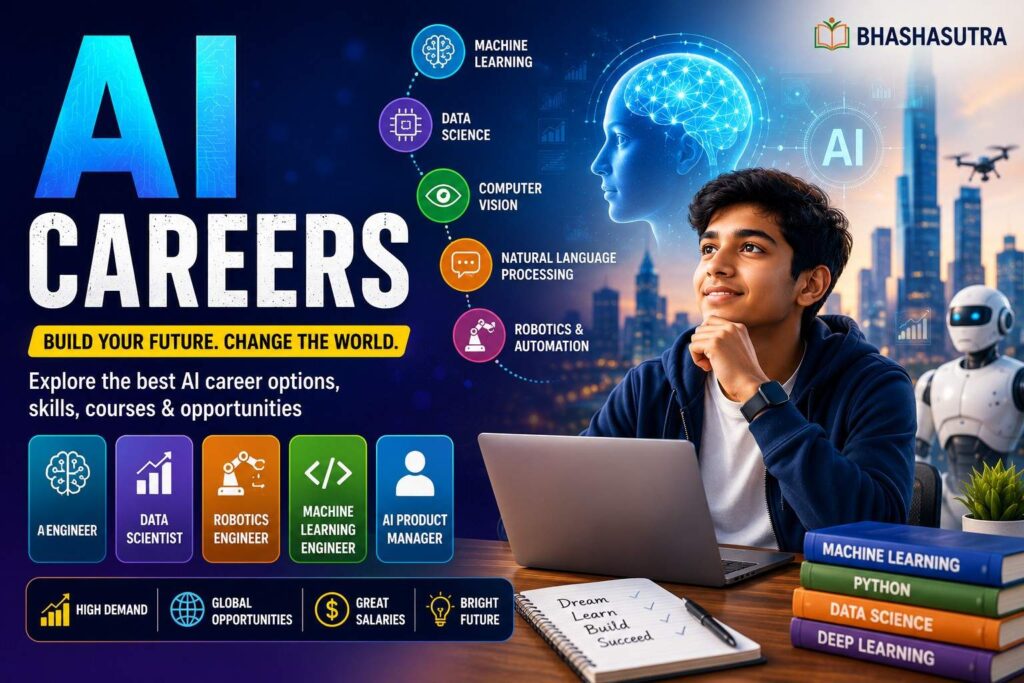
1. AI Engineer
AI Engineers develop intelligent software and systems that can learn, analyse information, and make decisions.
They build applications used in healthcare, banking, education, robotics, and many other industries.
2. Machine Learning Engineer
Machine Learning Engineers create computer models that improve automatically by learning from data.
Examples include:
- Recommendation systems
- Fraud detection
- Voice recognition
- Language translation
3. Data Scientist
Data Scientists collect and analyse large amounts of information to help organisations make better decisions.
Students who enjoy mathematics, statistics, and logical thinking often find this career rewarding.
4. Data Analyst
Data Analysts organise and study business data to identify trends and prepare reports.
This is often an excellent starting point for students interested in data-related careers.
5. Robotics Engineer
Robotics Engineers design intelligent machines used in industries, hospitals, agriculture, warehouses, and manufacturing.
Robotics and AI often work together to automate complex tasks.
6. Computer Vision Engineer
Computer Vision Engineers develop systems that allow computers to understand images and videos.
Their work is used in:
- Face recognition
- Medical imaging
- Autonomous vehicles
- Security systems
7. Natural Language Processing (NLP) Engineer
NLP Engineers help computers understand and communicate using human language.
Their work powers:
- Chatbots
- Translation software
- Voice assistants
- AI writing tools
8. AI Research Scientist
Research Scientists develop new AI technologies and improve existing ones.
They often work in universities, research organisations, and technology companies.
9. AI Product Manager
Not every AI career requires advanced programming.
AI Product Managers understand customer needs, plan AI-based products, and coordinate development teams.
Strong communication and leadership skills are important for this role.
10. AI Ethics and Governance Specialist
As AI becomes more powerful, organisations need experts who ensure AI systems are safe, fair, transparent, and responsible.
This is a rapidly growing career field.
Which Courses Can Lead to an AI Career?
Different countries and universities offer different programmes, but common options include:
- Computer Science
- Artificial Intelligence
- Machine Learning
- Data Science
- Information Technology
- Software Engineering
- Computer Applications
Many professionals also strengthen their knowledge through online courses, certifications, internships, and personal projects.
Skills You Need for an AI Career
Technical knowledge is important, but success in AI also depends on personal skills.
Technical Skills
- Programming (especially Python)
- Mathematics
- Statistics
- Data Analysis
- Machine Learning
- Problem-solving
Soft Skills
- Creativity
- Communication
- Critical Thinking
- Teamwork
- Curiosity
- Adaptability
The willingness to keep learning is one of the most valuable qualities in this field.
Can Students from Any Stream Build an AI Career?
Many technical AI roles require a strong background in mathematics and computer science.
However, AI is creating opportunities in many areas beyond programming.
Students interested in business, design, education, communication, law, healthcare, or management can also work in AI-related roles depending on their qualifications and interests.
Always check the admission requirements of the course or institution you plan to join.
Industries That Hire AI Professionals
AI professionals work in many sectors, including:
- Healthcare
- Finance
- Education
- Agriculture
- E-commerce
- Manufacturing
- Government
- Defence
- Entertainment
- Media
- Automobile Industry
- Environmental Research
AI is becoming valuable in almost every industry.
Common Myths About AI Careers
Myth 1: AI will replace all human jobs.
Reality: AI is changing many jobs, but it is also creating entirely new careers. People who learn AI skills are likely to have more opportunities in the future.
Myth 2: Only brilliant students can learn AI.
Reality: AI requires dedication and practice, but students can learn step by step with the right guidance.
Myth 3: AI is only for programmers.
Reality: AI also needs researchers, designers, educators, business analysts, product managers, policy experts, and communication specialists.
Tips for Students Who Want to Build an AI Career
If you are interested in AI:
- Strengthen your mathematics and logical reasoning.
- Learn basic programming.
- Improve your English communication skills.
- Build small AI or coding projects.
- Read about new technology regularly.
- Participate in workshops and competitions.
- Stay curious and keep learning.
Success in AI comes from consistent effort, not overnight results.
Ministry of Electronics & Information Technology
AI for India
NASSCOM
A Message for Parents
Artificial Intelligence is creating exciting opportunities across the world.
If your child enjoys solving problems, exploring technology, or learning new skills, encourage them to discover AI.
Support them in building strong fundamentals, practical experience, and confidence rather than focusing only on examination marks.
Children who enjoy learning are better prepared for the future than those who simply memorise information.
A Message for Students
Do not worry if you have never written a line of code.
Every expert was once a beginner.
Start with small steps.
Learn consistently.
Practise regularly.
Ask questions.
Keep improving.
The future belongs to those who never stop learning.
Final Thoughts
Artificial Intelligence is no longer just a technology of the future—it is already shaping the present.
From healthcare and education to banking, transportation, agriculture, and entertainment, AI is creating exciting career opportunities across the world.
Whether you dream of becoming an AI Engineer, Data Scientist, Robotics Engineer, or AI Product Manager, remember that success depends on continuous learning, practical experience, curiosity, and dedication.
Choose a career that matches your interests, develop your skills step by step, and use technology to create solutions that improve people’s lives.
The future is full of possibilities, and AI is one of the most exciting paths to explore.
Medical Courses Without NEET
Students interested in healthcare can also explore our detailed guide on Medical Courses Without NEET. https://www.bhashasutra.in/medical-courses-without-neet/
Frequently Asked Questions (FAQs)
1. Is AI a good career?
Yes. AI is one of the fastest-growing career fields, offering opportunities across many industries worldwide.
2. Which course is best for an AI career?
Popular options include Computer Science, Artificial Intelligence, Machine Learning, Data Science, Information Technology, and Software Engineering.
3. Do I need coding for AI?
Programming is important for many AI roles, especially Python. However, some AI-related careers focus more on product management, business, education, design, or ethics.
4. Can AI replace human jobs?
AI is changing many jobs, but it is also creating new career opportunities. People who develop AI-related skills are likely to benefit from these changes.
5. What skills are most important for AI careers?
Students should focus on programming, mathematics, logical thinking, communication, creativity, teamwork, and a willingness to learn continuously.
BY – BHASHASUTRA
JEE vs NEET
Read our comparison of JEE vs NEET to understand different career pathways after Class 12
https://www.bhashasutra.in/neet-or-jee-which-is-better-for-you-a-clear-guide-for-students-parents/