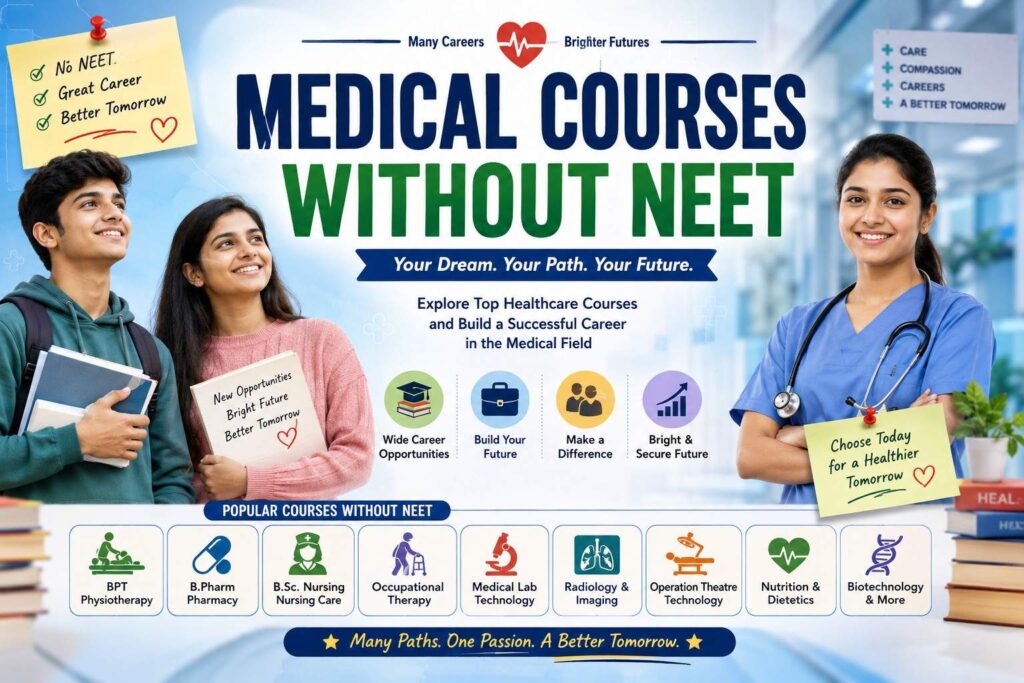
“I want to work in the medical field, but I couldn’t clear NEET. Is my dream over?”
This is one of the most common questions students and parents ask after the NEET results are announced.
The answer is No.
NEET is essential for admission to MBBS, BDS, AYUSH (BAMS, BHMS, BUMS, BSMS), BVSc, and some other medical programs, but it is not required for many excellent healthcare and allied health science courses. These courses offer rewarding careers, good salaries, and opportunities to serve society.
If you have a passion for healthcare but do not wish to pursue MBBS or are unable to secure a NEET score, there are many other career paths waiting for you.
Let’s explore them.
Why Students Look for Medical Courses Without NEET
Every year, lakhs of students appear for NEET, but only a limited number of seats are available.
Some students:
- Do not qualify for NEET.
- Do not want to repeat a year.
- Prefer shorter professional courses.
- Want to start earning earlier.
- Discover that they are more interested in diagnostics, rehabilitation, technology, nutrition, or patient care than becoming a doctor.
Healthcare is much bigger than becoming an MBBS doctor. Hospitals depend on a large team of trained professionals working together.
Medical Courses Without NEET
Here are some popular options.
1. Bachelor of Physiotherapy (BPT)
Physiotherapists help people recover from injuries, surgeries, sports injuries, and neurological conditions.
Course Duration
4½ years (including internship in many universities)
Career Opportunities
- Hospitals
- Sports academies
- Rehabilitation centres
- Private clinics
- Fitness centres
This is one of the most respected healthcare careers without MBBS.
2. Bachelor of Pharmacy (B.Pharm)
Pharmacists understand medicines, their preparation, safe use, and patient guidance.
Course Duration
4 years
Career Opportunities
- Pharmaceutical companies
- Drug research
- Medical stores
- Hospitals
- Government sector
Students interested in chemistry often enjoy this field.
3. B.Sc. Nursing
Nurses are among the most important members of every healthcare team.
Course Duration
4 years
Career Opportunities
- Government hospitals
- Private hospitals
- Military nursing
- Community health
- International opportunities
Admission requirements vary by institution and regulations. Some nursing admissions may involve entrance requirements or NEET depending on current state or institutional policies. Always verify the latest admission criteria before applying.
4. Bachelor of Occupational Therapy (BOT)
Occupational therapists help patients regain independence after illness, injury, or disability.
They work with:
- Children
- Elderly people
- Accident victims
- Stroke patients
Demand for occupational therapists is increasing across India.
5. B.Sc. Medical Laboratory Technology (MLT)
Laboratory professionals perform medical tests that help doctors diagnose diseases.
Work Areas
- Blood testing
- Microbiology
- Pathology
- Biochemistry
- Diagnostic laboratories
Almost every hospital needs skilled laboratory technologists.
6. B.Sc. Radiology and Medical Imaging Technology
Radiology professionals operate imaging equipment such as:
- X-ray
- CT Scan
- MRI
- Ultrasound (subject to role and regulations)
This course combines healthcare with modern technology.
7. B.Sc. Operation Theatre Technology (OTT)
Operation Theatre Technologists assist surgeons before, during, and after surgeries.
They maintain surgical equipment and ensure smooth operation theatre management.
8. B.Sc. Dialysis Technology
These professionals operate dialysis machines and care for patients with kidney diseases.
As kidney-related illnesses increase, trained dialysis technologists are in high demand.
9. B.Sc. Cardiac Care Technology
Students learn about:
- Heart monitoring
- ECG
- Cardiac procedures
- Intensive cardiac care
They work closely with cardiologists.
10. B.Sc. Optometry
Optometrists examine eyesight and prescribe corrective lenses. They also detect many eye-related problems and refer patients when necessary.
Career Opportunities
- Eye hospitals
- Optical clinics
- Vision centres
- Private practice
11. B.Sc. Nutrition and Dietetics
Nutritionists guide people on healthy eating habits.
They work with:
- Hospitals
- Sports teams
- Schools
- Wellness centres
- Corporate organisations
As awareness about healthy lifestyles grows, this field continues to expand.
12. B.Sc. Biotechnology
Biotechnology combines biology with technology.
Students may work in:
- Research laboratories
- Pharmaceutical companies
- Biotechnology firms
- Food industries
- Agricultural research
This course is ideal for students who enjoy scientific research.
Diploma Courses in Healthcare
Students can also choose diploma programmes such as:
- Diploma in Medical Laboratory Technology (DMLT)
- Diploma in X-Ray Technology
- Diploma in Dialysis Technology
- Diploma in Operation Theatre Technology
- Diploma in ECG Technology
- Diploma in Emergency Medical Technology
- Diploma in Physiotherapy (where available)
These courses generally have a shorter duration and can help students enter the healthcare workforce sooner.
Skills Needed for a Successful Healthcare Career
Whatever course you choose, success depends on developing qualities such as:
- Compassion
- Patience
- Communication skills
- Teamwork
- Responsibility
- Attention to detail
- Willingness to keep learning
Healthcare professionals touch people’s lives every day. Technical knowledge is important, but kindness and professionalism matter just as much.
How to Choose the Right Course
Before making a decision, ask yourself:
- Which subjects do I enjoy the most?
- Do I like working directly with patients?
- Am I interested in laboratory work or medical technology?
- Would I enjoy research?
- What are the career opportunities after graduation?
- Does the course match my strengths and interests?
Never choose a course simply because your friends are choosing it.
Common Myths About Medical Courses Without NEET
Myth 1: Only MBBS has a good career.
Reality: Hospitals rely on a wide range of healthcare professionals, including nurses, physiotherapists, laboratory technologists, pharmacists, radiographers, and many others.
Myth 2: Salaries are always low.
Reality: Earnings depend on your skills, experience, employer, location, and specialisation. Many allied health professionals build successful and financially rewarding careers.
Myth 3: There are no jobs.
Reality: India’s healthcare sector continues to grow, creating opportunities in hospitals, diagnostics, rehabilitation, pharmaceuticals, research, public health, and private practice.
A Message for Parents
If your child does not qualify for NEET, please remember that one examination does not define their future.
Every child has different strengths.
Instead of focusing only on MBBS, explore the many healthcare careers available today. Encourage your child to choose a field that matches their interests and abilities.
A motivated student in the right profession often achieves far more than someone who follows a path without passion.
A Message for Students
Do not lose confidence if your NEET result is not what you hoped for.
Success is not about one exam. It is about finding the right path, working hard, and continuing to learn.
The healthcare profession offers many meaningful careers where you can improve lives, support patients, and make a real difference to society.
Your dream of working in healthcare can still become a reality.
Final Thoughts
NEET is an important entrance examination for several medical programmes, but it is not the only gateway to a successful healthcare career.
From physiotherapy and pharmacy to medical laboratory technology, radiology, nutrition, and biotechnology, there are numerous opportunities to build a respected and fulfilling profession.
Take time to research each course carefully, understand the admission requirements of individual colleges, and choose a career based on your interests, strengths, and long-term goals.
Remember, success comes from dedication, continuous learning, and the desire to serve others—not from the name of a single course.
Students should always verify the latest admission rules on the National Medical Commission (NMC) website.
Link to:
Or:
For admission updates, check the official websites of the respective universities and counselling authorities.
JEE vs NEET: Difficulty, Salary & Career Comparison (2026 Guide)Blogs
Frequently Asked Questions (FAQs)
1. Can I study a medical-related course without NEET?
Yes. Many allied health science and healthcare programmes have admission processes that do not require NEET. However, admission criteria vary by university and state, so always check the latest official requirements.
2. Which is the best medical course without NEET?
There is no single “best” course. Popular options include BPT, B.Pharm, B.Sc. Medical Laboratory Technology, Optometry, Radiology, Occupational Therapy, Nutrition and Dietetics, and Biotechnology. The right choice depends on your interests and career goals.
3. Can I get a government job after these courses?
Yes. Depending on the course and recruitment rules, graduates may find opportunities in government hospitals, public health departments, research institutions, and other healthcare organisations.
4. Are these courses good for future career growth?
Yes. Many healthcare professions offer opportunities for higher studies, specialisation, research, teaching, management, and private practice.
5. How should I choose the right course?
Consider your interests, strengths, eligibility, course curriculum, career prospects, accreditation, and the reputation of the college before making a decision.
BY – BHASHASUTRA