
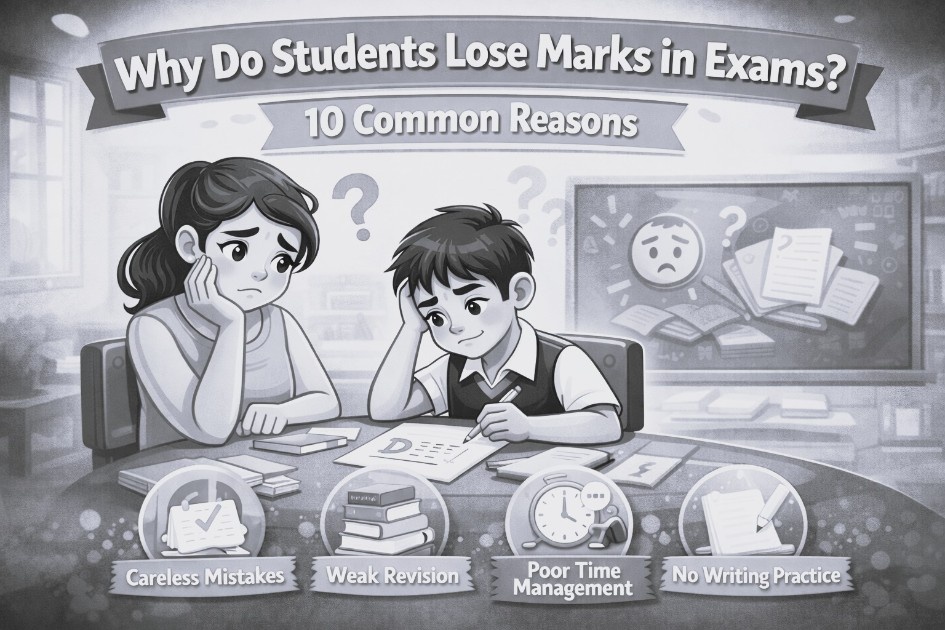
Many students work hard throughout the year, attend classes regularly, and study before exams. Yet, when the results come, they often feel disappointed because their marks are lower than expected. This situation is quite common and can be frustrating for both students and parents.
In my years of teaching school students, I have noticed that students often lose marks not because they do not know the subject, but because of a few common and avoidable mistakes. Once students become aware of these mistakes, they can improve their exam performance significantly.
Let us look at some of the most common reasons why students lose marks in exams and what they can do to avoid them.
1. Not Reading the Question Carefully
One of the most frequent mistakes students make is not reading the question properly. In a hurry, they start writing the answer without understanding what the question actually asks.
Sometimes the question requires a specific explanation or example, but the student writes something slightly different.
How to avoid it:
- Read each question carefully at least twice.
- Pay attention to important words in the question.
- Take a moment to think before starting the answer.
2. Poor Time Management During the Exam
Many students spend too much time on the first few questions and then rush through the rest of the paper.
As a result, the last answers may be incomplete or written in a hurry.
How to avoid it:
- Quickly scan the entire question paper at the beginning.
- Decide roughly how much time to spend on each section.
- Keep the last 5–10 minutes for revision.
3. Lack of Clear Writing
Even when students know the correct answer, they may lose marks if their writing is unclear or poorly organised.
Examiners appreciate answers that are neatly written and logically arranged.
How to avoid it:
- Write in clear paragraphs.
- Avoid writing everything in one long block of text.
- Present ideas in a simple and structured way.
4. Spelling and Grammar Mistakes
In language subjects especially, spelling and grammar mistakes can reduce marks.
Sometimes students know the answer but write too quickly and make careless errors.
How to avoid it:
- Write slowly and carefully.
- Pay attention to spelling and matras in Hindi or Marathi.
- Recheck the answer if time allows.
5. Writing Too Much or Too Little
Some students believe that longer answers will automatically earn more marks. Others write very short answers that lack sufficient explanation.
Both situations can lead to loss of marks.
How to avoid it:
- Write answers that are clear and relevant.
- Include important points without unnecessary repetition.
6. Not Practicing Writing Enough
Many students spend most of their study time reading or memorising lessons but do very little writing practice.
During exams, they may struggle to express their thoughts clearly.
How to avoid it:
- Practice writing answers regularly.
- Solve sample questions and past papers.
- Get feedback from teachers whenever possible.
7. Weak Revision Before Exams
Last-minute studying often leads to confusion and incomplete preparation.
Students who revise regularly throughout the term usually perform better in exams.
How to avoid it:
- Revise lessons periodically instead of waiting until the last moment.
- Create a simple revision schedule before exams.
8. Careless Mistakes
Sometimes students lose marks due to small mistakes that could have been avoided with a little attention.
These may include skipping a question, misreading a word, or forgetting to complete an answer.
How to avoid it:
- Stay calm during the exam.
- Double-check your answers before submitting the paper.
9. Lack of Confidence During Exams
Even well-prepared students sometimes become nervous during exams. When confidence drops, it becomes harder to recall information or write answers properly.
How to avoid it:
- Prepare well in advance.
- Practice writing answers under timed conditions.
- Stay calm and focus on one question at a time.
10. Not Reviewing the Answer Sheet
Many students submit their answer sheet immediately after finishing the paper. However, a quick review often helps identify mistakes.
How to avoid it:
- Use the last few minutes to check your answers.
- Look for spelling errors, incomplete answers, or skipped questions.
A careful review can help save valuable marks.
A Small Message for Parents and Students
Exams are an important part of a student’s academic journey, but they should not become a source of unnecessary stress. Instead of focusing only on marks, it is more helpful to understand where improvement is needed.
When students learn from their mistakes and develop better study habits, their performance improves naturally over time.
Parents can support their children by encouraging regular study routines, writing practice, and a positive attitude toward learning.
Conclusion
Students often lose marks in exams due to small mistakes such as not reading questions carefully, poor time management, weak revision, or lack of writing practice. The encouraging news is that these problems can be corrected with awareness and consistent effort.
By developing good study habits and practicing regularly, students can avoid these common mistakes and perform much better in their exams.
BY – BHASHASUTRA TEAM
About Bhashasutra
At Bhashasutra, we believe that strong language skills and clear writing play an important role in academic success. Our programs focus on helping students improve their Hindi and Marathi writing through structured practice, expert feedback, and thoughtful guidance designed especially for school students.